Integration strategy
Blueprints that map data flows, APIs, and automation opportunities.
- System maps and dependency analysis
- API standards and lifecycle governance
- Integration backlog and prioritisation

Your systems should work together — not force your team to manually copy data between them. We connect platforms, build M-Pesa and payment integrations, orchestrate APIs, and design data pipelines so information moves automatically, accurately, and auditably.
01 / What you get
Your systems should work together — not force your team to manually copy data between them. We connect platforms, build M-Pesa and payment integrations, orchestrate APIs, and design data pipelines so information moves automatically, accurately, and auditably. Whether it is replacing a spreadsheet bridge or building enterprise-wide integration infrastructure, we start with what is actually breaking today.
Talk to an engineer →Swipe highlights
01
Blueprints that map data flows, APIs, and automation opportunities.
02
Implementation of integrations, ETL pipelines, and workflow automations.
03
Observability, alerting, and runbooks ensuring data keeps flowing.
30s
Quote time — R4 Automotive
3
Supplier APIs — R4
700+
Applications — R4 hiring portal
<50ms
API p95 target
02 / Services
Scoped workstreams with clear owners, artefacts, and exit criteria — not open-ended retainers.
Swipe capabilities
Blueprints that map data flows, APIs, and automation opportunities.
Implementation of integrations, ETL pipelines, and workflow automations.
Observability, alerting, and runbooks ensuring data keeps flowing.
03 / Service benefits
We bias to evidence, documentation, and delivery rhythm — the parts that keep programmes honest after the kickoff deck is forgotten.
See case studies →Swipe benefits
Benefit
Versioning, error semantics, and retry rules spelled out before two vendors blame each other — common when African enterprises stitch global SaaS to local rails.
Benefit
Idempotent callbacks, settlement files, and ledger alignment so finance closes the day without spreadsheet surgery.
Benefit
Lineage, retention, and access controls for data moving between ERP, CRM, and data stores — evidence-friendly for CBK, donor, or ISO-style reviews.
Benefit
Dashboards and alerts on the handful of flows that drive revenue — not noise from every microservice when your team is five engineers, not fifty.
Benefit
Deployment windows and rollback paths aligned to peak traffic on mobile networks and retail hours — fewer “we will fix tonight” messages to customers.
04 / How we work
A steady cadence from immersion to handover — you always know what is in flight and what is next.
Swipe phases
Discovery & mapping
Understand current system landscape, data models, and business priorities.
Understand current system landscape, data models, and business priorities.
Build & iterate
Implement integrations in waves with testing, documentation, and stakeholder demos.
Implement integrations in waves with testing, documentation, and stakeholder demos.
Operate & optimise
Monitor performance, tune workflows, and enable your teams with runbooks.
Monitor performance, tune workflows, and enable your teams with runbooks.
05 / Real projects

Case study
R4 Automotive
Measurable delivery drawn from our published write-up — scope, stack, and timeline on the full page.
30s From search to quote · 700+ Recruitment applications · 3 Supplier APIs integrated
06 / Industries
Where we have delivery context — regulation, integrations, and operating models that generic shops miss.
6 sectors · indexed by delivery depth
Fintechs
E-commerce
Logistics
SACCOs & cooperatives
Healthcare
Retail
Illustrative phasing — exact timelines follow discovery and scope lock.
Swipe timeline
07 / FAQ
Prefer a conversation? We respond within one business day.
ContactCase studies and field notes for operators and technical leaders.
Swipe articles
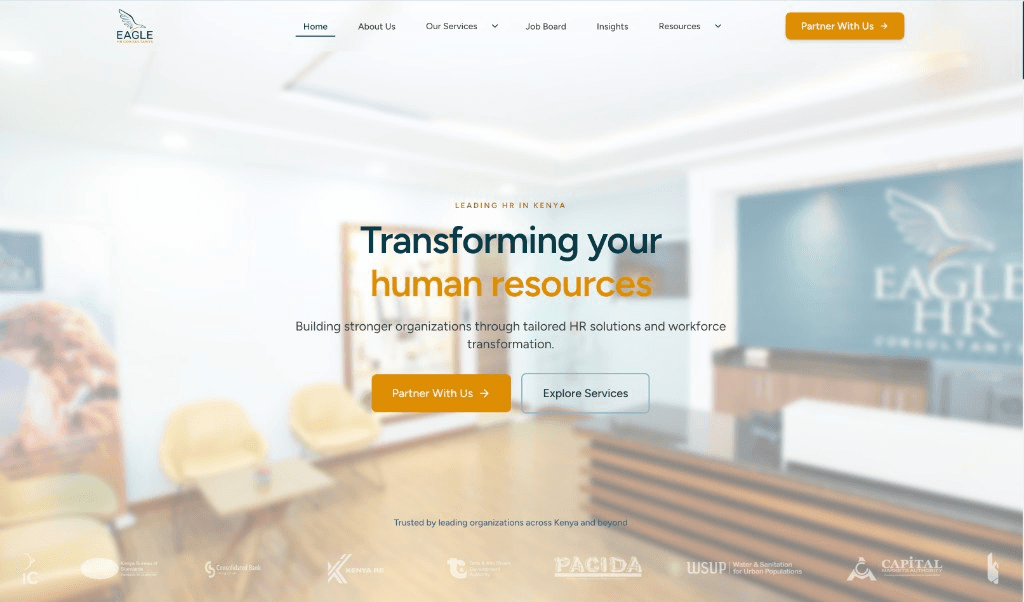
Case study
Scope locking, data model, and delivery cadence for a full HR operating system.
Read article
14 min read
Production patterns from R4 Automotive — OAuth, STK push, and callback discipline.
Read article
10 min read
What Kenyan SACCOs get wrong when going digital — and how to avoid them.
Read articleNext step
List the systems involved and what “done” means for users. We reply with an integration outline, testing approach, and ownership split.
Replies within 1 business day · NDA on request · Free 30-min discovery

Scope, deadlines, or a one-page problem statement—enough for a substantive first response.